Who Was Lech Walesa?
Lech Wałęsa was a Polish electrician, trade-union leader and political activist who became the face of Solidarity, the independent workers’ movement that challenged Poland’s communist government in the 1980s. Awarded the Nobel Peace Prize in 1983, Wałęsa helped lead negotiations that culminated in Poland’s landmark 1989 elections, which broke the Communist Party’s hold on power and accelerated the collapse of communist rule across Eastern Europe.
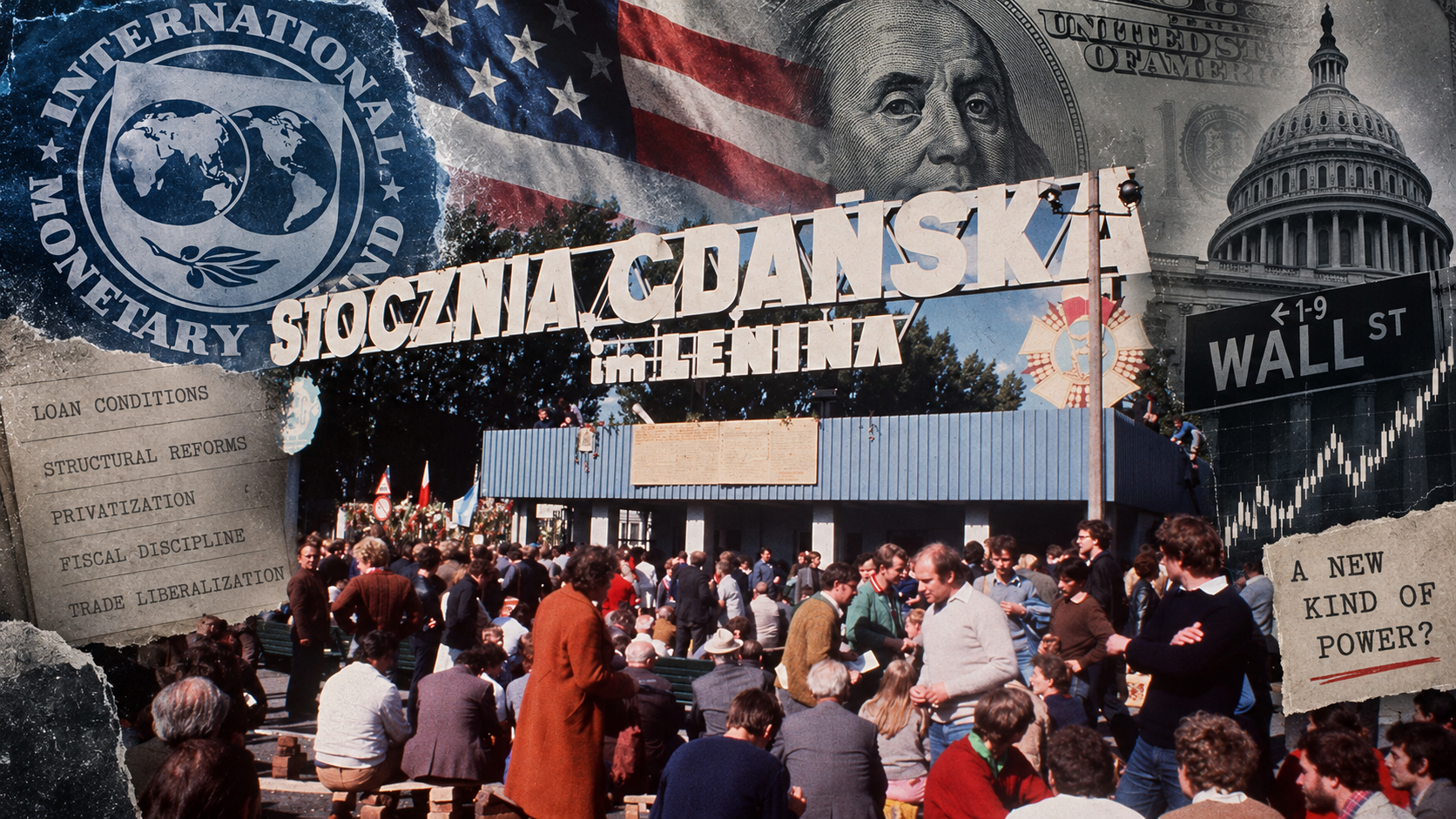
But overthrowing communism was only the beginning of the story. Wałęsa and Solidarity inherited an economy in crisis and billions of dollars of debt accumulated under the regime they had fought to defeat. What followed placed Poland at the centre of another transformation: a rapid experiment in free-market “shock therapy,” backed by Western governments and institutions, that showed how American influence in the post-Cold War world could be exercised through economics.
From Shipyard Electrician to Solidarity Leader
Lech Wałęsa was an unlikely candidate to become one of the men who helped bring down communism in Eastern Europe. Born in 1943 in German-occupied Poland, he trained as an electrician before finding work at the Lenin Shipyard in Gdańsk in 1967. It was there that he became involved in Poland’s growing labour unrest.
The shipyard workers had good reason to be angry. Poland was officially a workers’ state, yet independent trade unions were forbidden and strikes could be met with force. In December 1970, protests erupted along Poland’s Baltic coast after the communist government suddenly announced steep increases in food prices.
Security forces opened fire on demonstrators, killing dozens. Wałęsa participated in the unrest and subsequently became increasingly involved in organising workers outside the official union structure.
In August 1980, another increase in food prices helped trigger a new wave of strikes. Workers at the Lenin Shipyard walked out after the dismissal of crane operator and activist Anna Walentynowicz. Wałęsa (who was no longer even employed there) made his way into the shipyard and joined the strike, quickly emerging as its leader.
Workers from enterprises across the region joined the movement, while the strikers demanded not merely higher wages but the right to establish independent trade unions, freedom of speech, the release of political prisoners and other political and economic reforms.
A government that claimed to rule on behalf of the working class was now facing a mass rebellion led by workers themselves.
Within months, Solidarity had attracted around 10 million members—roughly a third of Poland’s population and an extraordinary challenge to the Communist Party’s monopoly on organised political life. The movement included factory workers, intellectuals, students and dissidents, turning a labour dispute on the Baltic coast into a nationwide opposition movement.
Moscow and Poland’s communist leadership were not prepared to watch that challenge grow indefinitely. On December 13, 1981, General Wojciech Jaruzelski imposed martial law. Solidarity was suppressed, thousands of activists were detained and Wałęsa himself was held for almost a year.
Solidarity continued underground, while Wałęsa became an increasingly powerful international symbol of resistance to communist rule. In 1983, he was awarded the Nobel Peace Prize for his campaign for workers’ rights and political freedom. Fearing that the Polish authorities might prevent him from returning home if he travelled to Oslo, Wałęsa stayed in Poland and his wife, Danuta, accepted the prize on his behalf.
By the end of the decade, the economic and political system that had tried to destroy Solidarity was itself beginning to buckle. And Wałęsa was about to move from leading an outlawed trade union to negotiating the end of Communist Party rule.
When partially free elections were finally held in June 1989, the scale of Solidarity’s victory was extraordinary: its candidates won all 161 freely contested seats in the Sejm and 99 of the 100 seats in the newly restored Senate, exposing just how little popular support the communist regime had left.
The result demonstrated overwhelming public rejection of the regime, and two of the Communist Party’s satellite parties—the United Peasants’ Party and Democratic Party—subsequently defected and joined a Solidarity-led coalition. The communist prime-ministerial candidate Czesław Kiszczak couldn’t form a viable government.
Then, on 24 August 1989, Solidarity adviser Tadeusz Mazowiecki became Poland’s first non-communist prime minister since the immediate postwar period.
Solidarity Inherits Communism’s Bills
Under Communist Party leader Edward Gierek, the government had borrowed heavily from Western banks and governments in an attempt to modernise Polish industry, import Western technology and raise living standards.
By 1981, Poland could no longer service its foreign debt normally and entered negotiations with its Western creditors. The problem continued to grow throughout the decade. By the time Solidarity entered government in 1989, Poland owed foreign creditors roughly $40 billion, while inflation was accelerating and shortages remained widespread. The movement that had spent years fighting the communist state had effectively inherited its balance sheet.
There was an obvious political argument for relief. Why should Poland’s new democratic government be burdened by debts accumulated by the authoritarian regime it had just helped overthrow? Wałęsa and other Solidarity figures hoped that the West, which had celebrated their struggle against communism, would provide substantial assistance now that they had actually won.
But the George Bush administration, in power at the time, was reluctant to simply forgive the enormous debts owed to Western governments and banks. The principle remained that the Polish state was responsible for obligations contracted by its communist predecessor.
This created a strange situation. For years, the United States encouraged resistance to Soviet domination in Eastern Europe. Now that Poland was breaking free, its new leaders discovered that entry into the Western economic system came with constraints of its own. Poland desperately needed hard currency, debt relief and access to international finance, which meant negotiating with Western creditor governments, commercial banks and institutions such as the International Monetary Fund.
Sachs, Washington, IMF, Shock Therapy in Poland
One of the most influential outsiders to arrive in Poland at this tumultuous time was Jeffrey Sachs, a 34-year-old Harvard economist who had already advised Bolivia on its battle with hyperinflation. Working with fellow American economist David Lipton, Sachs began meeting Solidarity leaders in 1989 and argued against a gradual transition from communism. Poland should instead attempt what the two economists explicitly called a “shock” approach: rapidly stabilize prices while making a “sudden and comprehensive jump to a market economy.”
Sachs publicly called for a $700 million IMF loan, $500 million from the World Bank and, most importantly, a $1 billion stabilization fund from Western governments to provide hard-currency reserves behind the Polish zloty.
There was, however, a bargain implicit in Poland’s access to Western financial support. IMF lending came alongside a programme of fiscal and monetary tightening, reduced subsidies, price liberalization, wage restraint and opening the economy to international trade.
From Moscow to Washington
There was a bitter irony in Solidarity’s victory. Poland had finally broken free from a political and economic system imposed under Soviet domination, only to discover that political freedom didn’t mean complete freedom of economic action.
Accessing help in dealing with issues inherited from the Communist regime meant dealing with a new collection of powerful institutions: Western creditor governments, the IMF and World Bank, with the United States sitting at the centre of the international financial system.
Poland had escaped the Soviet economic system just as the American-led model of market capitalism was reaching the height of its global authority.
The timing was extraordinary. In 1989 itself, economist John Williamson coined the term “Washington Consensus” for the package of market-oriented policies increasingly associated with Washington’s economic institutions. Poland’s revolution therefore occurred at almost the exact historical moment when the collapse of communism appeared to leave the Western model without a serious ideological competitor.
US State Department policymaker Francis Fukuyama even called this moment the end of history. But if the ideological contest was over, what did that mean for newly free countries whose path to prosperity now ran through an economic system dominated by the United States?
Recommended further reading

The Defeat of Solidarity: Anger and Politics in Postcommunist Europe by David Ost
Leave a Reply