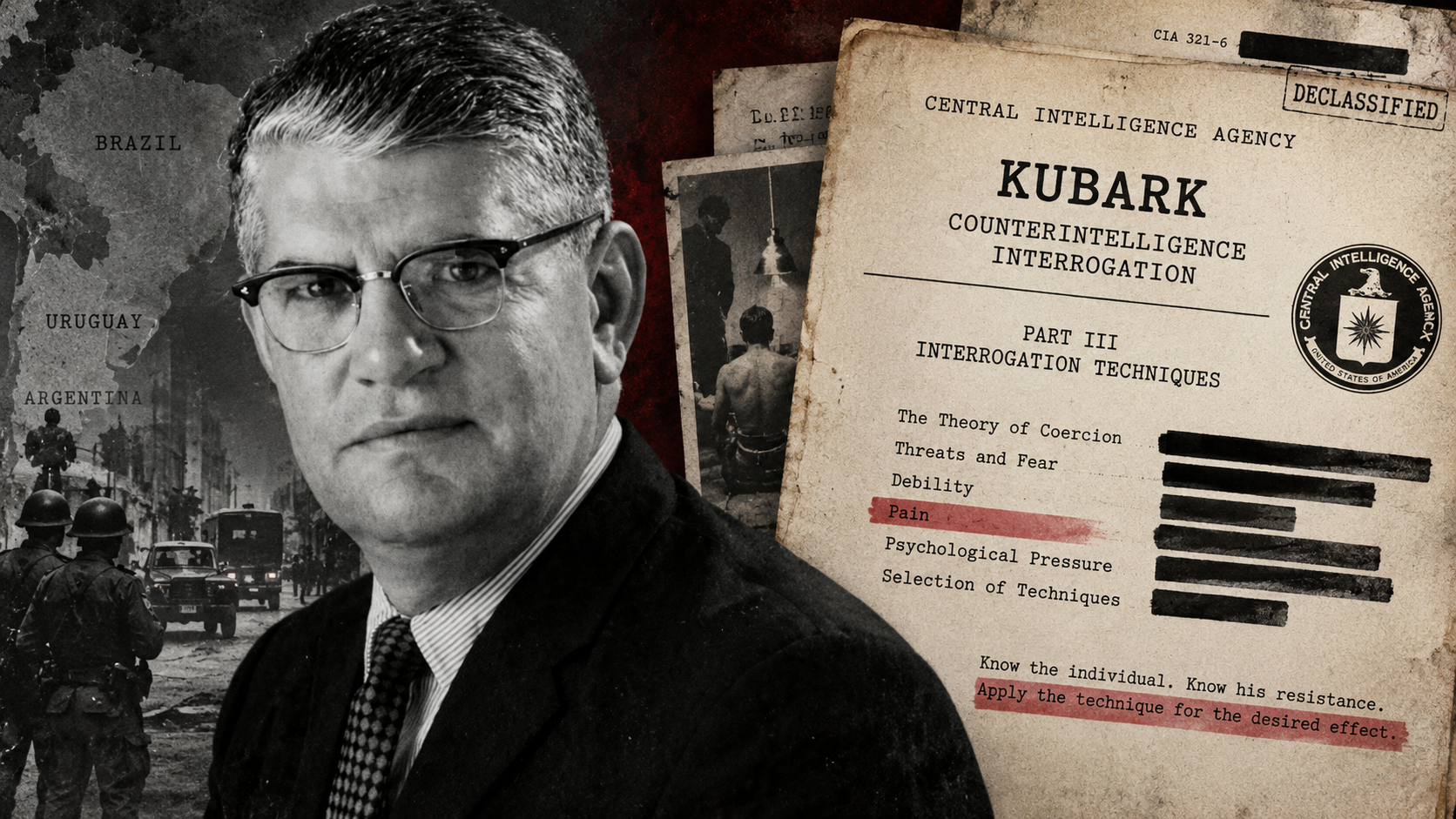
So, Who Was Dan Mitrione?
Dan Mitrione was an American police officer who became a U.S. government adviser in Latin America during the Cold War, training police forces in Brazil and Uruguay through the USAID Office of Public Safety. But his legacy is far darker than the job title suggests. Mitrione has been accused of teaching sophisticated torture and interrogation techniques to security forces fighting political “subversion”.
He allegedly took people from the streets as unwilling subjects in his demonstrations. His story offers a disturbing glimpse into how the United States helped professionalize counterinsurgency across Latin America. Mitrione’s methods bore striking similarities to coercive techniques being studied and systematized by the CIA during the same period.
Before Dan Mitrione: KUBARK & The CIA’s Search for a Science of Interrogation
To understand the world Dan Mitrione entered in Latin America, it helps to rewind a few years.
During the 1950s and early 1960s, the CIA poured considerable effort into understanding whether human behaviour could be manipulated in predictable ways. Under programmes such as BLUEBIRD, ARTICHOKE and the infamous MKULTRA, the agency experimented with everything from drugs and hypnosis to isolation and sensory deprivation. This often happened to people who had no idea they were being used as test subjects.
Out of this wider obsession with behavioural control emerged something rather more practical.
In July 1963, the CIA produced a secret manual called KUBARK Counterintelligence Interrogation. “KUBARK” was itself a CIA cryptonym, and the manual was intended to provide guidance for interrogating resistant sources.
Having a manual for coercion is arguably disturbing enough. But what makes KUBARK so unsettling is how clinical the whole thing is.
Interrogation is treated almost as a problem in applied psychology. It describes how one must understand the subject, weaken the psychological structures supporting their resistance, create dependency, and exploit vulnerability.
Among the coercive techniques discussed were solitary confinement and sensory deprivation, threats and fear, inducing physical weakness, pain, hypnosis and drugs. The manual also explored how stripping away familiar surroundings and routines could disorient a prisoner and weaken their sense of identity.
The War Against “Subversion” Comes to Latin America
Fidel Castro’s victory in Cuba in 1959 set alarm bells ringing in Washington. The fear was that Cuba would become both an example and a base for Marxist-Leninist revolution elsewhere in Latin America, encouraging armed guerrilla movements that could topple US-friendly governments and replace them with communist regimes.
Then, in 1964, Brazil’s military overthrew President João Goulart, who pushed a sweeping programme of “Basic Reforms” that included land redistribution and greater state control over parts of the economy. To his supporters, these were badly needed reforms in a deeply unequal country. To large landowners, business interests, political conservatives and much of the military, they looked increasingly like a lurch towards the radical left.
Goulart’s alliances with trade unions, left-wing nationalists and communists convinced his opponents (and many in Washington) that Brazil risked becoming another major Latin American country lost to communism. On 31 March 1964, sections of the Brazilian military moved against him. Goulart fled the country days later, beginning more than two decades of military rule.
The United States supported the new regime, and the institutions receiving American police and security assistance increasingly became part of a state apparatus tasked with suppressing its political opponents.
This is where Dan Mitrione enters the picture.
Enter Dan Mitrione
Mitrione had actually been in Brazil since 1960, when he arrived in Belo Horizonte as part of a US programme for training and modernizing foreign police forces. Mitrione was one of six American police advisers sent by the International Cooperation Administration (ICA), the predecessor of USAID.
At first, much of his work was decidedly less sinister than his later reputation suggests. He taught riot-control techniques and the use of tear gas and batons, but also advised on such mundane matters as police uniforms and traffic control. This was the public face of American police assistance, essentially helping friendly governments build more modern and professional security forces.
After the 1964 coup, however, the purpose of those “security forces” was changing.
Brazil’s new military government was increasingly concerned with rooting out political “subversion.” Opposition hardened, armed resistance emerged, and the country’s police and intelligence services became central to the regime’s effort to identify, interrogate and dismantle its enemies.
And this is where the accounts of Mitrione’s work become much darker.
One of the most disturbing comes from Manuel Hevia Cosculluela, a Cuban intelligence officer who claimed to have infiltrated the CIA while working with the US police programme in Uruguay. Hevia alleged that Mitrione didn’t merely discuss torture with the officers he trained in Brazil. He demonstrated it.
According to Hevia, homeless people were picked up from the streets of Belo Horizonte and used as human guinea pigs in training sessions. Electric shocks were allegedly administered while police officers watched as Mitrione demonstrated how pain could be controlled and calibrated during an interrogation.
Mitrione left Brazil in 1967 and returned to Washington, where he spent two years teaching at the International Police Academy.
Then, in 1969, the United States sent him back to South America. But this time he was going to Uruguay. And in Uruguay, there was considerably less ambiguity about why American police expertise was wanted.
Uruguay was confronting one of the strongest urban guerrilla movements in Latin America: the Tupamaros. Washington had established an AID Public Safety office in the country in 1964 specifically to assist police counterinsurgency operations. As the political crisis deepened, US Public Safety assistance, including police training, was doubled in 1969.
Mitrione arrived that year to head the programme.
As American-trained officers moved into important positions within the Uruguayan police, allegations of torture mounted. Historian A. J. Langguth would later conclude that Mitrione taught torture techniques to Uruguayan officers. Under Mitrione, he wrote, torture became routine at Montevideo police headquarters.
The System Turns on Mitrione
Mitrione’s work in Uruguay eventually made him a target of the very insurgency the country’s security forces were trying to destroy.
On July 31, 1970, the Tupamaros kidnapped Mitrione near his home in Montevideo as part of a wider campaign of abducting foreign officials. Their demand was the ambitious release of around 150 imprisoned Tupamaros in exchange for their hostages. Uruguayan president Jorge Pacheco Areco refused.
Behind the scenes, the Nixon administration scrambled to save Mitrione. President Richard Nixon personally urged Pacheco to “spare no effort” to secure his release, while US officials explored ransom payments and pressed the Uruguayan government to establish some form of communication with the kidnappers.
But one proposed tactic was considerably darker.
A declassified cable from Secretary of State William Rogers suggested that Uruguay consider threatening to kill imprisoned Tupamaro leaders if Mitrione was executed. The US ambassador subsequently reported that prisoners had been warned that a death squad could retaliate against their relatives if Mitrione were killed.
None of it saved him.
On August 10, after ten days in captivity and with the government still refusing the demanded prisoner exchange, Mitrione’s body was discovered in a stolen car in Montevideo. He had been shot at close range.
There is a grim circularity to the story. Mitrione had been sent to Uruguay to help strengthen the state’s response to a Marxist guerrilla movement. That work helped make him valuable enough for the Tupamaros to seize as leverage; and the escalating struggle between the guerrillas and the security state ultimately consumed him too.
Torture as a Science
Mitrione has been described as approaching torture almost as a science. The objective wasn’t to inflict as much pain as possible, or to allow an interrogator’s anger to take over. Pain had to be controlled; too little might achieve nothing; too much could kill the prisoner before the interrogator got what he wanted.
A. J. Langguth attributed a chilling maxim to Mitrione: “The precise pain, in the precise place, in the precise amount, for the desired effect.” He also described Mitrione as believing that premature death during an interrogation meant the technique had failed.
It’s difficult to read that without thinking back to KUBARK.
The CIA manual approached coercion with the same clinical detachment. It discussed the psychological effects of fear, isolation, debility and pain, and instructed interrogators that coercive techniques should be carefully chosen according to their effects on the individual being questioned.
The parallel here places Mitrione within a much wider American effort to turn coercive interrogation into something systematic. Basically, understand how people respond to fear and pain, determine which techniques break resistance, and teach others how to apply them.
In KUBARK, that thinking appeared in the antiseptic language of an intelligence manual. In the accounts of Mitrione’s work in Latin America, we see what something remarkably similar allegedly looked like in practice.
Recommended Further Reading

A. J. Langguth — Hidden Terrors: The Truth About U.S. Police Operations in Latin America
If you want to go deeper into Dan Mitrione and the wider story of U.S. police operations in Cold War Latin America, this is one of the key books on the subject.
Leave a Reply