What Happened on August 19, 1953?
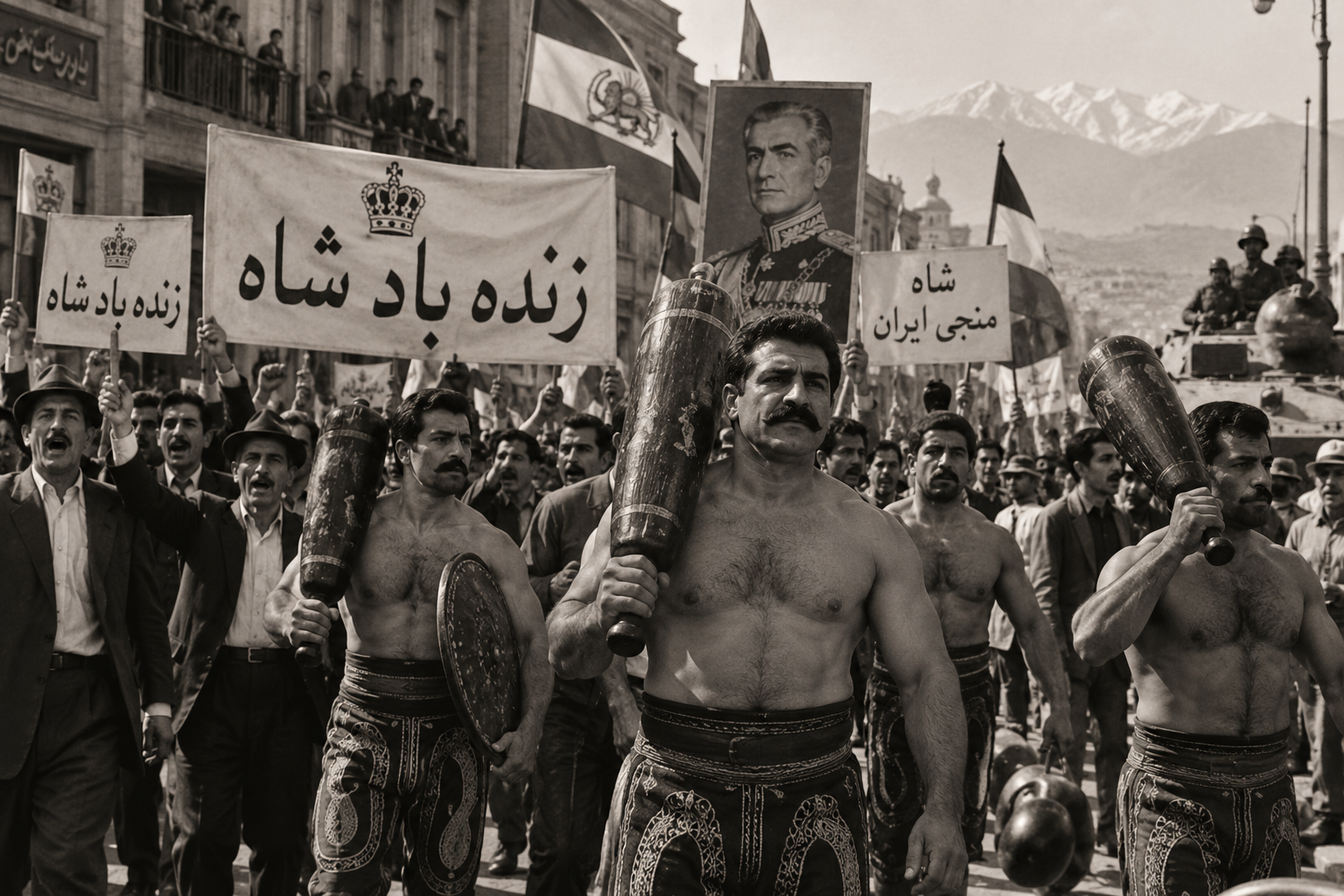
On August 19 1953, events transpired that changed the course of Iranian history. The events involved Iranian wrestlers marching through Tehran, fomenting chaos as part of a CIA-backed coup. Things started with economic changes and pressure. And they ended with the demise of Prime Minister Mohammad Mossadegh.
In 2026, the United States is once again trying to squeeze Iran’s economy. An “economic onslaught”, they’re calling it.
The logic behind economic warfare is straightforward. Make ordinary economic life sufficiently difficult, isolate a government from the outside world, and hope that pressure eventually produces political change from within.
The thing is, Iran has experienced this before. And on August 19, 1953, that story took a particularly strange turn.
That morning, wrestlers and strongmen emerged from Tehran’s traditional zurkhanehs and joined crowds moving through the capital. By the end of the day, Prime Minister Mohammad Mossadegh’s government was effectively finished.
To understand how Persian wrestlers ended up mixed up in a CIA-backed coup, though, you have to start with oil.
The man who took on the British
When Mossadegh became prime minister in 1951, Iran possessed one of the world’s great oil reserves.
The problem was that Britain had an enormous say over what happened to it.
The Anglo-Iranian Oil Company (the ancestor of today’s BP) controlled Iran’s hugely valuable oil industry under terms many Iranians had come to regard as humiliating.
Mossadegh had built much of his political career around the idea that Iran should control its own resources.
In 1951, Iran’s parliament voted to nationalise the oil industry. Britain was furious, but the staunch Mossadegh wasn’t only challenging British interests.
Iran at the time was still an extraordinarily unequal society in which wealthy landowners exercised enormous economic and political power.
In 1952, Mossadegh introduced an ambitious package of rural reforms. Landlords were ordered to give up 20 percent of their share of agricultural income. Half would go directly to peasants; the other half would help fund things like village cooperatives, irrigation and sanitation.
Back then, much like America is doing now with its “economic onslaught”, Britain attempted to make nationalisation economically disastrous.
Iranian oil was effectively shut out of international markets. Britain imposed an embargo and used its enormous influence over the global oil industry to deter companies from buying Iranian crude.
The thinking from the Brits was that if Mossadegh couldn’t sell the oil he had just nationalised, nationalisation would start looking considerably less like a triumph. Government finances would suffer, economic discontent would grow, and Mossadegh’s political coalition might fracture.
In other words, pressure applied from outside Iran could help create pressure inside it. Much like Trump’s thinking (or his advisors’ thinking) in the present-day conflict.
Enter the CIA
Initially, Washington wasn’t nearly as enthusiastic about overthrowing Mossadegh as London was.
But by 1953, Dwight Eisenhower was in the White House and Cold War fears about communism were intensifying. American policy on Iran shifted in light of the Red Scare.
Britain’s MI6 and the CIA began working together on a plan to remove Mossadegh and strengthen the position of Shah Mohammad Reza Pahlavi.
The American operation was known as TPAJAX. It depended heavily on the involvement of Iranians.
Money was spent on propaganda and political influence. Contacts were cultivated within the military. Iranian intermediaries worked with politicians, religious figures, newspaper editors, and people capable of putting bodies onto Tehran’s streets.
And that last requirement brings us somewhere you probably wouldn’t expect to find in the history of the CIA.
A Persian gym.
Welcome to the zurkhaneh
A zurkhaneh (literally a “house of strength”) isn’t much like a branch of your local Planet Fitness.
It’s an ancient Iranian sporting institution combining strength training, wrestling, ritual, music and Persian cultural traditions.
Athletes train in a sunken octagonal pit. They perform rhythmic exercises. They swing huge wooden clubs called meels. A musician known as a morshed traditionally beats a drum and recites poetry while the men train.
The most respected athletes could become pahlavans: champion strongmen whose status extended beyond sport.
And in mid-century Tehran, some of these men also occupied a rather different social world.
Certain strongmen had connections to neighbourhood gangs, bazaars and street politics. Their physical presence and local followings meant they could be useful when somebody needed a crowd.
August 19, 1953
The first attempt to remove Mossadegh didn’t go particularly well. The Shah even fled the country, ending up in Rome. For a moment, it looked as though the coup had failed.
Then came August 19. Pro-Shah groups, funded by Kermit Roosevelt’s CIA dollars, began moving through Tehran. Among the crowds were wrestlers, weightlifters and strongmen associated with the city’s zurkhanehs.
They weren’t some secret CIA wrestling battalion, as the story is occasionally simplified online. The precise relationships between individual street leaders, Iranian intermediaries and foreign intelligence remain considerably messier than that.
But the CIA and British intelligence had been actively cultivating networks capable of generating political unrest, and traditional strongmen became part of the pro-Shah street mobilisation that helped change the course of the day.
The crowds grew and pro-Mossadegh newspapers were attacked. Government buildings and radio facilities became targets, while military units joined the pro-Shah side.
Eventually tanks surrounded Mossadegh’s residence. By the end of August 19, his government had fallen.
The Shah returned to Iran shortly afterwards, where he would rule for another 26 years. In fact, his very rule is what led to the fundamentalist Islamic regime that Trump and the US are so against. And yet you can easily argue that the Islamic regime is in place because of America.
Perhaps more presciently, in both 1953 and 2026, the US gambled that economic pain could be converted into political change inside Iran. But once you deliberately destabilize a society, you don’t get to choose neatly what emerges from that instability. You might get huge wrestlers causing havoc and stirring up mass crowds.
Who knows what forces that economic pressure might unleash this time?
Recommended further reading

All the Shah’s Men – Stephen Kinzer
Leave a Reply