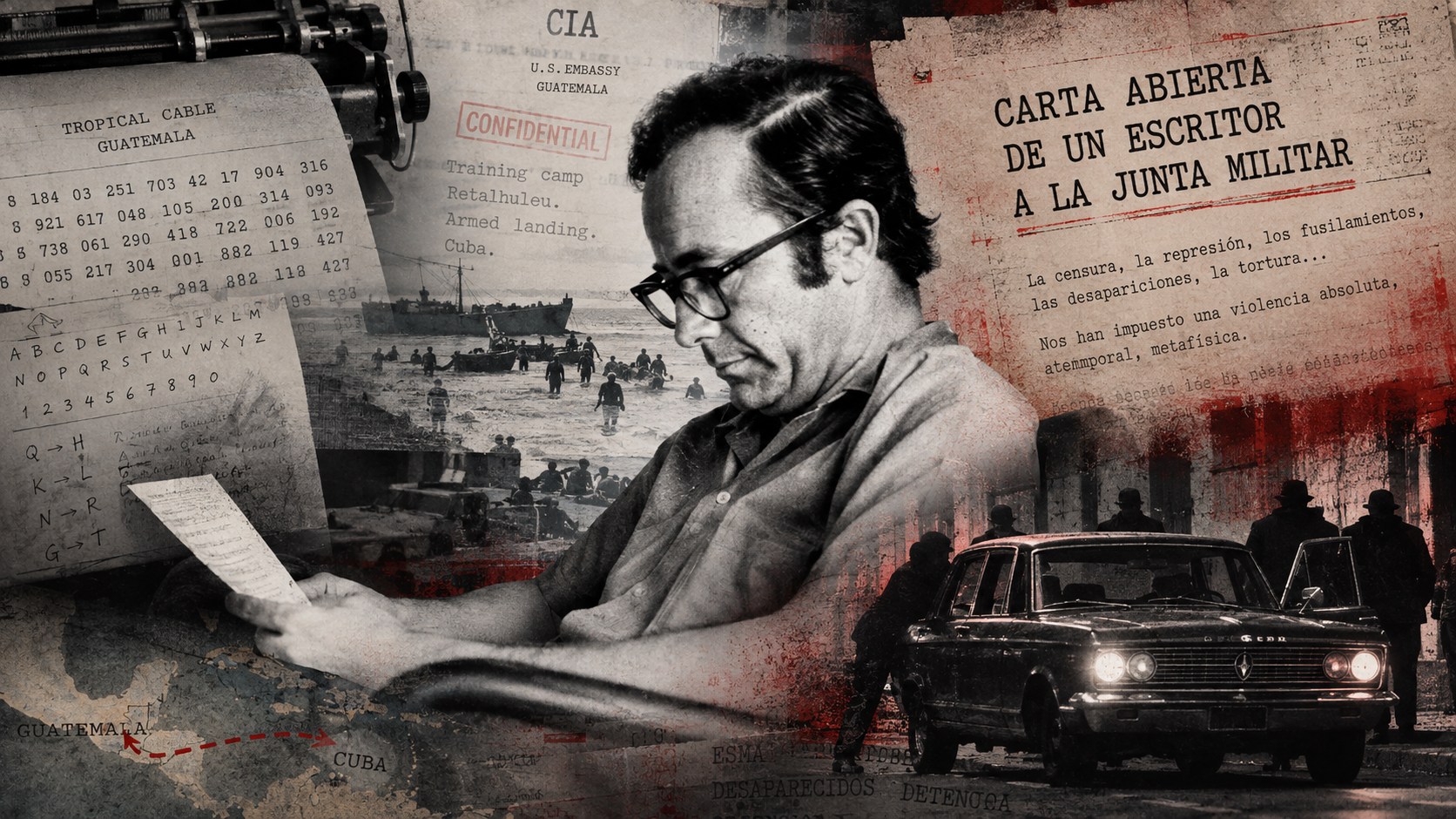
Who Was Rodolfo Walsh?
Rodolfo Walsh was an Argentine journalist, writer and revolutionary best known for exposing state violence and political crimes before being eliminated by Argentina’s military dictatorship in 1977. But his remarkable story also intersected repeatedly with the hidden machinery of American power in Latin America, from cracking a coded message that exposed an invasion by the US, to investigating the foreign connections of Argentina’s security forces.
Investigative Journalist and Cryptographer
In the spring of 1961, Walsh was in Havana, and he found himself staring at a message that he was not supposed to understand.
Rodolfo was thirty-four years old, Argentine, self-taught, and possessed of the peculiar kind of mind that found puzzles difficult to leave. He had already written detective fiction and exposed a secret execution carried out by Argentina’s military government. Now, he was working for Prensa Latina, the Cuban news agency established after Fidel Castro’s revolution, when a coded cable came into his hands.
Walsh seems to have possessed the temperament of a natural sleuth. He loved chess, wrote detective stories and had already demonstrated an unusual willingness to worry at discrepancies until an official story came apart. Long before “open-source intelligence” became a profession, he was doing something recognizably similar with scraps of information, documents, and human sources. Boston Review describes him aptly as a “self-taught sleuth and code breaker.”
I’ve spent much of my own career writing about cybersecurity, where encrypted communications, intercepted messages and the accidental exposure of information are everyday subjects. Walsh’s encounter with American intelligence sounds almost implausibly modern, except that it happened more than sixty years ago, and the technology involved was a roll of paper coming out of a teletype machine.
According to acclaimed author Gabriel García Márquez, who worked alongside him at Prensa Latina and later told the story, Walsh bought cryptography manuals from a second-hand bookshop in Havana and spent a succession of sleepless nights attacking the message. Eventually, he cracked it.
The message itself was commercial traffic belonging to Tropical Cable, a subsidiary of All America Cables operating in Guatemala.
The message had been sent to Washington by a CIA official attached to the U.S. Embassy in Guatemala. It described preparations for an American-backed armed landing in Cuba and, crucially, identified Retalhuleu, a former coffee plantation in Guatemala, as a location where recruits were being trained.
Walsh had stumbled into one of the CIA’s most consequential covert operations, the Bay of Pigs invasion. The decoded message gave Fidel Castro’s government advance warning that a U.S.-backed invasion force was being trained in Guatemala.
Journalist and Intelligence Officer
By the 1970s, Walsh had crossed a line that complicates any simple portrayal of him as an independent investigative journalist. He joined the Montoneros, the left-wing Peronist guerrilla organization engaged in an increasingly violent struggle with the Argentine state. His talents made him particularly useful: Walsh worked in intelligence and communications, applying the same obsessive appetite for information that had once led him to crack the mysterious cable in Havana.
After the military seized power on March 24, 1976, however, the terrain changed dramatically. The junta began systematically abducting suspected opponents into a clandestine network of detention centres. Torture, murder and disappearance allowed the regime to conduct much of its repression outside courts, prisons and official statistics.
Walsh began trying to document what the dictatorship was attempting to hide. He helped establish ANCLA, a clandestine news agency that collected information on the regime’s activities and circulated reports despite censorship.
By early 1977, he was preparing something more direct.
On the first anniversary of the coup, Walsh completed “An Open Letter from a Writer to the Military Junta.” Copies were produced and mailed to newspapers and foreign correspondents, part of the clandestine circulation by which he hoped the document would escape the regime’s control.
He described disappearances, clandestine detention, executions and torture. Because prisoners officially ceased to exist after being abducted, Walsh argued, torture itself had escaped its previous temporal limits. The junta had arrived, in one of the letter’s most memorable formulations, at “absolute, timeless, metaphysical” torture—violence that had ceased merely to extract information and had become an assault on the human being itself.
But buried in Walsh’s catalogue of Argentine repression was something particularly relevant to the story of American power in Latin America.
He pointed beyond Argentina.
Walsh alleged that the Foreign Affairs Department of the Argentine Federal Police was run by officers who had received CIA-linked training through the U.S. Agency for International Development (AID). He specifically named commissioners Juan Gattei and Antonio Gettor and connected them to CIA station chief Gardener Hathaway. He also placed Argentina’s repression within a wider regional pattern extending across Chile, Bolivia and Uruguay.
Whether the specific names mentioned were involved, the broader point was true. American security assistance had spent years helping train and professionalize police and security services across Latin America.
And here the strange symmetry in Walsh’s life becomes difficult to ignore. In 1960, an accidentally intercepted cable had led him to a CIA-backed army being prepared in Guatemala for an invasion of Cuba. Sixteen years later, investigating repression in his own country, Walsh again found American fingerprints.
American intervention in Latin America wasn’t confined to spectacular moments like the Bay of Pigs or the overthrow of governments. Training programmes, intelligence relationships and counterinsurgency expertise could outlive the particular crises for which they had originally been created.
The connection is not that Washington created Argentina’s Dirty War, but rather that institutions and relationships built during earlier American efforts to contain communism could acquire lives (and consequences) of their own
The Ford Falcons Arrive
On March 25, 1977, Walsh travelled into Buenos Aires carrying copies of his letter. He had typed the final copy the previous night. He posted copies to Argentine newspapers and foreign correspondents, but he wouldn’t make it home.
That afternoon, as Walsh walked along Avenida San Juan in Buenos Aires, the junta closed in on him.
Court proceedings decades later established that somewhere between twenty-five and thirty members of Task Unit 3.3.2 were involved, spread across more than half a dozen vehicles.
One of them was a Ford Falcon.
By 1977, that was an ominous car to encounter on an Argentine street. Falcons—particularly the unmarked vehicles used by security forces—had become intimately associated with the dictatorship’s clandestine machinery of abduction. People could be seized without warrant, pushed into waiting cars and taken to detention centres that officially did not exist. The car became one of the enduring visual symbols of the Dirty War.
Walsh appears to have understood what was happening. When the task force moved in, he reached for the small .22-calibre pistol he was carrying. What followed was hopelessly unequal. According to the facts subsequently established in the ESMA case, officers opened fire and Walsh was struck repeatedly in the chest and killed. His charred remains were dumped into a river.
Recommended further reading

Operation Massacre – Rodolfo Walsh
Operation Massacre follows Walsh’s investigation into a clandestine 1956 execution after he discovered that some of its supposed victims were still alive. Part detective story, part investigative journalism, the English edition also includes his final Open Letter from a Writer to the Military Junta.